Tuesday, March 26, 2013

Let's Talk Critique Pt 2

Welcome to part two of Let’s Talk Critique. This is where we’ll talk about “how” good crit partners do what they do. If you missed the “what,” check it out here.

There’s a lot of common wisdom out there about how a crit partner (cp) can go about critiquing without being a giant douchecanoe. This is good because there’s no certification process for learning how to crit. I'm certain my critique style is heavily influenced by having done an undergraduate degree in English Lit in which I was frequently asked to analyze capital-‘L’-Literature from a variety of perspectives (oh, Po-Mo, how I heart you). But I don't consider that adequate preparation for the work of thinking critically about something that's still in progress. It was just a starting point.

Most of the posts I’ve seen on the subject of crit revolve around the behavior of a good/bad cp, which easily accounts for half of what it takes to be a good cp. That’s the “partner” part of “critique partner,” and since that ground has been well and truly covered elsewhere, I’m going to continue the conversation by focusing on the “critique” part of “critique partner.”

As I work with my super stellar cps primarily via email, I'm focusing on crit-in-letter form. I can't really speak to the in-person dynamic of crit, but I imagine these still apply.

So! Here are Natalie's top 4 truths of making really good crit with action items and more Firefly gifs:

1. Be the best bad guy you can be.
We all know the sandwich method of critique: this is the good-crit-good school of critique. I think it bears repeating because pointing out the good can be challenging when you’re reading with a critical eye. But it IS important. Not because you need to make the author feel good (though, that’s part of it), but because this is frequently the hard part of a good critique.

It’s easy to look at a piece and find ways in which it could be better; it’s not always so easy to find its strengths especially in drafting stages. But finding the love is where you lay the groundwork of a good critique. If I’m going to tell you that your main character’s emotional arc is missing key beats and is therefore unrealized in the end, then I’d better also be able to tell you that the arc you’re striving for is visible precisely because you’ve established the starting point so well. It's easy to be a bad guy. It's tough to be a good bad guy.

Action item: Make your compliments/encouragements as insightful as your critiques.

2. Navigate the ‘I’.
This is a tough one because most of us come to writing as readers, and as readers we're encouraged to identify with characters - or, at least, that's what we learn in school. But! In the case of crit, you're not a reader, you're a critiquer, and what you would do is therefor irrelevant. 

Okay. Maybe not totally irrelevant, but it should probably take a backseat to your analysis of the work. If your gut reaction to something in the text is to argue that it's not believable because you wouldn't behave as the main character did, there's probably a reason, but it doesn't have anything to do with you.

For example. Let's say you were critiquing for me and I gave you a piece about a vampire slaying space cowboy with the ability to download personalities like software and maintain quippy dialogue throughout. And let's say there was a scene in which said vampire slaying space cowboy hides under her bed to escape an invasion of zombies.

Instead of saying, "if I were a vampire slaying space cowboy with the ability to download whatever personality I wanted, I wouldn't hide beneath my bed from something as mundane as zombies," you might practice removing yourself from the equation and consider why that's your reaction. In this case, it might be because I hadn't properly illuminated the fact that this vampire slaying space cowboy had a horrific experience with zombies in her childhood and lacks the confidence needed to meet them face on.

Action item: Read your crit letter for 'I' statements and consider how to restate them in a way that removes you from the picture. Be creative!

3. Aim before you fire. 
Once the critical glasses are on, it can be difficult to moderate them. But! Too much of a good thing is like the 4th Indiana Jones movie - people only really remember the first three with fondness.

It's easy to get swept up in the excitement of a good crit. You can see all the things! You can be useful! And brilliant! And point out the universe of problems!

Well. Don't.

This is where it's helpful to know your terrain and pick your battles wisely. This is also a part of critique that is hugely flexible and will shift depending on your relationship with the writer. 

Speaking in general terms, a well-aimed crit is worth more than an exhaustive one. If you see a wealth of trouble in a manuscript, it may be best to address only the most salient issues - for example, you might prioritize the character arc over addressing voice, or major plot issues over problems with smaller scenes. In these cases, the bone saw is more useful than the scalpel. Remember: the elements of storytelling are connected and addressing one is, in some ways, addressing all.

Action item: Practice condensing critique notes or demonstrating relationships between them.

4. Be clear. Be concise. Be nice.
Revise your crit letters. Especially in the early stages of working with a new partner, precision is kindness. Take the time to organize your thoughts and make them incisive without abandoning niceties - it's possible to say hard things without being mean, but it definitely takes practice.

Similarly, crit letters aren't soapboxes; there's no need to write a treatise on the inherent fault of zombie/vampire/werewolf mythologies (see aforementioned comment about behaving like a douchecanoe). I promise you this is a surefire way to lose the goodwill of your critique-ee.

Trust that the author knows that zombies/vampires/werewolves can't exist (well....except for zombies), and focus instead on why in the context of their manuscript, the mythology is weak. Which is to say, anyone can tell me my zombies are improbable, but a good cp will tell me why my zombies are unbelievable. A great cp will do that with a single statement and a smile.

Action item: Revise, revise, revise your crit letters just as you did the manuscript. 

The thing these all have in common is creativity. We don't usually think about crit as being creative. Critique is the necessarily academic component of writing a novel. It's strict, the disciplinarian of daydreams. It reigns us in and cools us down and counters impossible yes's with irritatingly realistic no's. But. (You knew there was a but.) BUT. (But did you know there were two?) A really good critique does all of that in a way that leaves you burning to try again - to be better than you were last time. A really good critique isn't a monster waiting to swallow your bones, it's the whetting stone there to sharpen your sword.

So, there you have it. How Natalie approaches crit. Again, this has little to do with behaving like a good cp. Behavior is another boat. Or another post if you're interested.

Friday, March 22, 2013

Let's Talk Critique Pt 1

In the past 6 months, I've had the opportunity to critique manuscripts for three people I've never worked with before. I always warn people that my critiques can be rough if you're not very familiar with critique, and these were no exception. To illustrate, each of these crit letters was 2k and over.

The interesting thing about these, and the reason I'm posting about it, is that they were for writers at very different stages of the process. One was just starting out, one a seasoned writer making strides toward publication, and one a debut author. In each of these cases, comments were made about my critique style and how I learned it. Which got me thinking that this might be a topic more people are interested in.

Fast forward to this week, when Maggie Stiefvater posted her CP Love Connection and it seems perfectly timely. As an aside, I highly recommend you start there if you're looking for a creative hook up. And remember to check the postings on her mirrored blogs.

So, let's talk about critique and what it means to be a partner. This will be a post in two parts. Part one (that's this part) on the "what" of crit; part two on the "how." (Part three if I think of something else). 

I know that there are people who have elaborate hierarchies of the various sets and subsets of critique partners. People talk about Alpha readers and Beta readers and for all I know they have Gamma, Delta, Epsilon, and Zeta readers, too. But I'm going to break things down into the three levels reflected most precisely in the publishing process: Editor, Line Editor, Copy Editor. They will all serve you well, but in very different ways. And please know that though I'm speaking in very general terms, I'm talking about my own experience in the wild and sundry world of critique.

What does an editor do?
I'm feeling bullet-y today. Let's use those.
  • Read for over-arching consistency and integrity in the story. This is the big picture, so big, you're in space looking down at the earth, discovering how the continent you want to build will fit in the vast scheme of things. In other words, plot and character arcs - do they work? Are they realized?
  • Give attention to the movements within a story and transitions between them. This is probably the medium-sized picture, from the earth's atmosphere on a clear day where you can see the topography of this new continent. In other words, subplots, setting, and tone - are they adding to the story?
  • Be aware of the momentum of the story. This is the most focused view; you're on the ground navigating the path you charted from atmo. In other words, pacing, pacing, pacing - which scenes drag at the story? What quiet moments are missing?
Editing comes first. An Editor reads for each of these levels of storytelling and can communicate with you about them. An editor is the person who gets what you're trying to do and is invested in helping you achieve that goal as precisely as possible. This is where critique partners are most helpful because they act as your editor before you have an editor.  

What does a line editor do?
  • Voice and point of view. Are they consistent throughout?
  • Word choice and sentence structure. Do the word choices and sentences relate to specific character arcs? Is pacing consistent with sentence structure?
  • Pacing and rhythm within the text. Should you consider condensing a paragraph into one or two lines? Do you over-use pronouns or specific sentence type?
To be clear, of course CPs can do this for you. I've done it, but this very different work from actual critique. Line editing will to very little to help a writer address overarching problems in the narrative, so doing too much of this before a critique can be a waste of your time. 

What does a copy editor do?
  • Read for consistency in descriptions. Do your characters have the same hair color throughout? Did you spell the name of the town consistently? Did your protagonists mother drive a Prius at the beginning and an SUV at the end?
  • Find problems with internal logic. Can your character actually cross a certain distance in the time they say they can?
  • Words, words, words. Grammar and style (both the author's and the publisher's). Do you love the Oxford comma? Always spell gray with an 'e'? 
A copy editor focuses on grammar and sense. This is the nitty gritty. Their job is to make sure each sentence functions as intended and makes sense unto itself, and to make sure the reality in your head isn't wildly off base. This is the very final stage of the editing process and has very, very little to do with critique. 

To be clear, I think a CP can do all of these levels of editing, but it's the first level that is the most crucial. You wrote a book, which makes you brilliant, but a CP who can point to the major plot hole in your work is just as brilliant. A CP who can point to the plot hole and also how the fix for that hole already established in the manuscript well, they're the best in the 'verse. If your CP only gives you line notes and copy edits, you don't actually have a CP. 

So now that I know what I'm looking for, how do I find a good critique partner?

Finding a good CP can be tough. Having swapped manuscripts with dozens of people, I know that being in the trenches can be so frustrating you begin to question the worth of the quest. But don't give up! There's no training for this job. As with writing, many of us learn by doing, and that means that every time you swap a manuscript, you are both learning and teaching someone how to give critique. 

My best advice is to keep swapping - establishing rules such as those in Maggie's post before you trade - with an eye for those who can critique on the editor level. 

There are several resources online that will help you connect with similarly situated writers. I'll list more below, but if you know of others, please drop them in the comments. You can also reach out to local chapters of SCBWI or your library to see what crit groups are active in your area, but I've had the best success online. 

Resources
In addition to Maggie's connection, the following are great places to cruise for creatives:
Stay tuned for Part 2! HOW to give good crit. 

Tuesday, March 19, 2013

Hello! My Name is Natalie.

It's been so long, I'm afraid you've forgotten my face. Allow me to re-introduce myself. My name is Natalie and we've met, but it was last year and my hair was probably a different color....

I haven't been posting. There are reasons - 2012 went out with an apocalyptic bang and 2013 entered similarly - but I've not forgotten my dear blog. Consider this my reentry to the blogosphere.

Here's is the quick update of what I've been up to:
  1. I've teamed up with a diverse group of debuting YA authors and we've just launched our blog. We are The Fourteenery - 14 YA Authors Debuting in 2014. (Obligatory prize post here). This is a group of women I've been working with for several months and I'm excited and delighted to be engaged in this collaborative venture.
  2. Tumblr! I love it. And I'm Obviously Parker (obviously).
  3. The Official 2014 Debut Young Adult and Middle Grade author group has launched! If you'd like the bird's eye view of what's coming down those roads, check out the OneFour KidLit blog and/or Twitter feed.
  4. Texas! For the first time in my life, I visited the great state of Texas for a writing retreat. 21 writers, 5 days, 2 houses, 1 river. As you can imagine, it was as exhausting as it was recharging.
In lieu of anything more, I'll leave you with this picture of the world's largest pecan. Which I found in Texas. And touched.
More soon. Ciao for now.

Sunday, January 6, 2013

How the Ocean Trapped Me

This year for the holiday, my family decided it would be best to rent a beach house in order to accommodate everyone with their own bedroom -- such is the way of everyone being an adult and picky. It was a good idea. It was my idea. And we quickly zeroed in on Dauphin Island as the perfect destination. Not only that, but we narrowed our search down even further to a house at the far western tip of that island where nothing but shrubs and grass grow and all is sand and water.

(I'm not being dramatic. That's all totally serious and true.)

Background: Dauphin Island is a barrier island off the coast of Mobile, Alabama. It's not too far from our home in Gulfport, Mississippi, nor is it very large. As islands go, it's barely there (6 square miles!), but it's historically significant as being a few hundred yards from Admiral Farragut when he spoke the words, "Damn the torpedoes, full speed ahead!" during the battle of Mobile Bay in the Civil War.

Well, renting houses online is an exciting thing. Websites and photos give you a general idea of the place you're about to spend quality time in, but you can never really know what it'll be like until you're pulling your car onto a sand-and-pebble driveway in front of a up-on-stilts-house while the ocean laps at the shore just feet away. There's just no real substitute for stepping out onto damp sand and looking South to the Gulf of Mexico, then North to Mobile bay - both close enough to splash. No real way to prepare for what it might mean should a storm roll in while you're living in this up-on-stilts-house on an island with one road down the center...

As you've probably guessed, this is exactly what happened. On Christmas day, winter storm Euclid tore across the country and in the south, he called to the seas. "Rise up! Rise up!" He cried. "Higher! Louder! Steal that driveway! SHAKE THAT HOUSE!"

It was insane. The house shook every time the waves crashed against the stilts (a-ha! this is why they're on stilts!), which might have been lulling had I not been wondering just how deep those stilts were buried in the earth. I hoped they were all in the bedrock, but suspected not. By 10:00pm, the ocean had swallowed the bottom step leading to the driveway, turning the sand to muck, and the waves were nearing the road.

That's about when we stopped looking. We were in it for the long haul no matter how high the seas got. The tornado warnings kept going, but houses on stilts HAVE NO BASEMENTS. So we decided to get some sleep, and hope for the best.

Obviously, I'm still here, but the next morning was...interesting. I've captured some of the aftermath for you...


Thanks to the realtor, we had enough warning to move our cars across the street, otherwise, my trusty vehicle might still be in Alabama...or on its way to Costa Rica.

We were stuck for two days and just as the water receded enough to get our cars back in the driveway, another storm rolled in and it started all over again.

Hope your holiday was a little less eventful and ten times more safe than mine.

(All that said, I would totally stay in a up-on-stilts-house again. Just....in May or June.)

Friday, December 14, 2012

On funerals and family

I was eleven when my nonie died.

My parents decided that my sister and I were too little to deal with prolonged knowledge of her illness and only told us three months before her death that she had cancer. I remember where I was when my father called me inside to hear the news of her passing – standing in a four-foot-deep trench I’d been laboring over with my best friends, Tom and Mike. We had some notion that such a trench would help us capture one of the bullies in the neighborhood. What we would do after his capture, however, was a mystery, but that didn’t matter. The trench took weeks to dig and that was really the point of the exercise.

I don’t remember my reaction in the moment. I remember returning to that trench with my friends and having distant awareness that our trench was the exact shape and size of a grave.

We traveled to Mississippi where the family gathered. I remember feeling strangely detached and confused. I tried to understand. I knew death was sad. It was an ending and if the television was correct, there would be wailing and uncontrollable sobbing.

I waited for that to hit me and while I waited, I explained it to my little sister who, at the age of eight, was surely more lost than I was. It made me feel better.

“Rosie,” I said, “tomorrow is going to be a very sad day. People might not smile. We’ll have to be quiet.”

This was my way of preparing her (and myself) for a day with no laughter and no play. But when that day came, there were smiles everywhere I looked. My aunts and uncles smiled, my parents smiled, all the distant relatives I didn’t remember and couldn’t keep straight, they all smiled. They laughed and hugged and traded stories for hours. My favorite was the story of Nonie letting the horses follow her into the kitchen for a quick apple so long as Poppy wasn’t around to see.

It was many years before I would come to understand funerals. In fact, it was many years before I would attend another. I came to understand the sobbing and the wailing, I came to understand the laughter, and I came to understand how family weaves and unweaves itself around theses shades of sorrow.

Late this November, one day after I turned thirty-two, Poppy passed away.

This time, I returned home with equal parts sadness and anticipation. I knew there would be tears and difficult moments, strained throats and messy noses, but I also looked forward to seeing the aunts, uncles, and cousins who live all across the country.

I expected the reunion to be good. I expected it to come with surprises and stories and all the awkward moments imaginable. And it did. But it also came with moments so touching and humbling that I hardly knew how to react.

One of those moments was on the day of the funeral. After the service, the church had prepared a meal for the family and we all filed over to the gym to feast. I stood to the side with a few of my cousins, letting others go through the line first. One cousin, who I’ll call J, studying the buffet table, said, “Those better not be Chick-fil-a nuggets.”

This was a surprise. Of all the cousins and as far as I knew, I was the only one that fell in the LGBTQ spectrum. My cousins, all younger than me, didn't have to care that the church was serving food from an institution that actively takes an anti-LGBTQ stance and funds anti-LGBTQ causes. They didn't have to care, and yet, they did. They all did.

Cousin J went to the table, plucked one from the platter, and tasted it with the results we feared.

The rest of the cousins collectively sighed and as we moved through the buffet line, every single one of them walked quietly past the nuggets and instead filled their plates with potatoes and salad.

It was a quiet resistance and I marveled at the cousins I hardly knew all making that choice.

When my uncle sat at our table with a small pile of nuggets on his plate, no one said a thing. At least, not while I was there. I left the table at one point and when I returned, noticed that my uncle had pushed his nuggets to the side of his plate and didn’t eat a one.

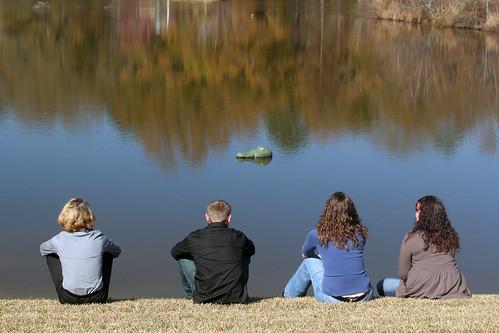
In some ways, this defied all expectation. This was certainly one of the last things I expected to learn about my Mississippi-based family while sitting in church. It was almost as absurd as discovering that my great-great grandmother’s middle name was Bobo. Almost as absurd as the number of roosters in my grandparents’ house. Almost as absurd as sprinkling Poppy’s ashes into the lake – his lake – ten feet from a floating gator head. But no less amazing and wonderful for it.

I thought I knew about funerals. I thought I knew that they were for the living – for mourning and remembering and moving on. But they’re also about discovering who we are now and how we fit together as pieces of a family.

Monday, November 19, 2012

Conversations with Mom

A short time ago, my sister and I visited my mom. While we were there, I decided to introduce them to The Vampire Diaries. It was really more for my sister, who I was sure would love the show every bit as much as I do. She did. But the surprise was that my mom did also. After I left, she continued to catch up through the end of season two. She missed season three entirely and one day, this happened.

(Note - all conversations with my mother improve if you imagine that she speaks like a Southern Belle.)

(Second note - she doesn't actually look like Katherine Pierce, but I don't have a handy picture of her in hoops.)

MOM: You remember that vampire show? The one you showed me?
ME: The Vampire Diaries?
MOM: Yeah. That one. Well. I turned on the TV the other day and there it was -
ME: Oh, no. You mean you caught the season 4 premiere?
MOM: Well, yeah. I guess. I just thought I'd be able to fill in the gaps on my own.
ME: *cringing* ....and?
MOM: And I'll be damned if Elena didn't turn into a vampire!

And then yesterday, we were chatting about nothing related to vampires when this happened.

MOM: Have you seen Lincoln, yet?
ME: No. I promise you I'll see Breaking Dawn 2 before I see anything else.
MOM: Oh! I hadn't done any of the Twilight things until just the other day when they showed the first two movies on TV. I watched them.
ME: ....and?
MOM: You know what I've decided? I've decided that the next time I get a pet, I'm going to get a werewolf.
ME: .....
MOM: Because I miss my cat, but I don't have a lot of time and if I got busy, my werewolf could just take care of itself. They're very self-sufficient and I think they're pretty. Don't you think they're pretty?
ME: .....I have to go internet you now.

So there you go. Some people post conversations with their children. I, apparently, post conversations with my mother.


Tuesday, November 13, 2012

On Attacking Baristas and Xylophones

I'm very protective of the music I use for writing. I search long and hard for the perfect collection of songs that can suffuse my brain with the tone I want to create in my novels. Every revision requires at least one new song to represent the shift, the new sense of climate I'm aiming to add to the story.

There's a small handful of people I'm willing to share my songs with. I can count them on one hand. It's not that I don't want to share my music, but I'm sort of afraid that if I give my story songs away, I'll dilute the power they hold over my subconscious. Somehow, I'm convinced that giving away the musical kernel of the novel is to give away the kernel of the story itself.

Irrational. I know. But it means that when I'm sitting in my coffeeshop, sipping my cappuccino on a Tuesday morning, and one of my hard-discovered songs comes over the speakers, I immediately leap to my feet and attack the mild-mannered, music-literate, cappuccino-making genius behind the counter with what I'm sure is a terrifying "WHY MY MUSIC, YOU THIEF????"

Don't fret. The encounter ended with mutual respect, one more cappuccino, and an exchange of music recommendations.

The point is, I'm as emotionally invested in my music as I am in my own novels. There's something really amazing about finding a song that perfectly captures a piece of my own imagination - the spark of a character, the first image of the story, the core of its emotion. It reminds me that I'm participating in a much larger tapestry of creative thought, adding to a conversation that's been going for hundreds of years in every medium storytellers can get their fingers on.

Which is my long-winded way of saying music is important to me, yo. (And I'm a little crazy about it).

As a way to further establish how crazy I am (and entertain you with my follies), I'll offer this final example.

About a week ago, M (one of the four people I share music with), sent me a song with the explanation, "you should listen to this because it's weird."

And it was. Weird. But oddly appealing. I filed the recommendation away for further thought and countered with a piece that was equally as odd, but far less appealing with attack xylophones. The point is we had a decent exchange about this piece of music.

Fast forward a week to two days ago when I encounter a song I think M will like. I send it and the following happens:

Me: Have you heard of this band? I like them so I think you will, too.
M: .....I have. Didn't I send you one of their weird songs last week?
Me: Um. You did? Did I like it?
M: You did. There's a problem with your brain.
Me: DON'T YOU THINK I KNOW?!

I'm on the prowl again. Searching for the music that will pattern my brain for the foreseeable future. Send your recs if you've got 'em!