
It's spring. Which means T and I will engage in dandelion warfare for approximately 93 days.
I don't mean that we'll join forces and seek to cleanse our yard of them, I mean we will argue about them. We'll argue about whether or not they're a weed, whether or not they're pretty, and whether or not they deserve to exist. For 93 days.
It goes something like this....
 Me: UGH. Look at that field of dandelions.
T: Pretty!
Me: No. They're not.
T: Look at that yellow! They're like sunlight!
Me: They're not sunlight, they're weeds.
T: GRASS IS A WEED, TOO.
Me: But it's a useful one.
T: Being pretty is useful. Just ask Keanu Reeves. How do you think he ever got cast in anything.
I see the point. If I step far enough back from my adult experience of dandelions, I can remember the joy child-Natalie would have felt at the sight of a field of fluff balls. I can divorce my thoughts from how widely those seeds will disperse, how like a virus they'll encroach on my yard, how like a Kraken they'll attach to my soil with a death-firm grip and instead see their oppressive beauty...
Sometimes, I'm more successful than others.
But as I was prying those little beasts from my lawn one evening, I had some time to consider how radically our perspective changes our reality. If, like T, I was content to find the beauty in a lawn full of dandelions, I'd save myself an awful lot of sweat and toil. I might be content to let them rule my yard in yellow fury. But without that perspective, I rooted around in the dirt for hours like a madwoman. I changed the landscape of my lawn little by little until only a few bits of yellow remained.
I didn't eradicate them completely because when there were only a few left, they were suddenly refreshing and beautiful against dark green grass - a metaphor for survival rather than oppression.
Having just come through a rather involved edit and a test-run of my Critique Crash Course, the timing seemed appropriate.
(Obviously, I was going to relate this to writing, right?)
In my last round of edits I was charged with tightening my novel. In the course of doing so, I grappled with finding a balance between pretty and over-written. I asked my author friends, "What does it mean to over-write? How do I know if I'm doing it? Where I'm doing it? How do I fix it?"
As you can imagine, I got a variety of really good answers. They ranged from "avoid too much repetition" to "don't flood a scene with gorgeous prose because you can" to "be efficient."
At first, this was really hard. All of my words appeared firmly rooted in place. There was no disturbing them. They belonged because I'd been over the manuscript enough to KNOW they belonged.
Hadn't I?
It was hard to tell, so I gave it to a friend and asked her to demonstrate which words were weedy and which were holding down the soil of the story. What she returned to me were pages so devastated I almost didn't recognize them. My knee jerked. I didn't want to believe there was THIS much to shed. What was left? How could the leftover words possibly carry the weight of the story.
But once I'd recovered from the shock, I started to see what she'd done - how she was teasing the story to the front by tamping down the fluff. I was able to analyze my prose simply by virtue of having someone come in and point out the weeds I mistook for flowers.
This was a new sort of revision for me. Not something I was prepared to do on my own, but a good reminder of why I need people to look at the same thing I'm looking at and tell me what they see. Sometimes the way to achieve a new perspective is by climbing onto the shoulders of someone else.
So here's what dandelions taught me about writing: pretty can be a virus. Too much of it and a manuscript can drown in the relentless monotony of it. There's a trick in shifting your perspective from flower to weed, and for me it was as exciting as a free cappuccino.
In the end, I culled the manuscript by 7k. I changed the landscape of the novel so that the language wasn't so cluttered, so that the story got more sun, so that the important bits didn't have to compete for water.
But I left the dandelions that became flowers in the process.


 This is a tough one because most of us come to writing as readers, and as readers we're encouraged to identify with characters - or, at least, that's what we learn in school. But! In the case of crit, you're not a reader, you're a critiquer, and what you would do is therefor irrelevant.




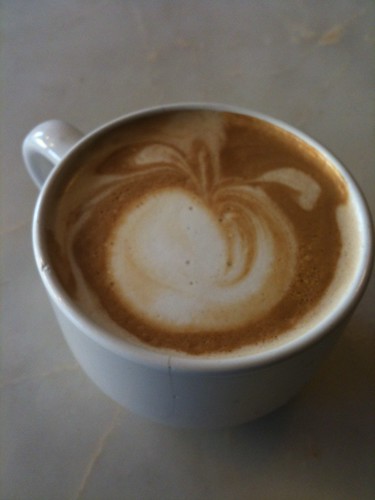


 There's something about winter that makes a cappuccino at any hour of the day sound like a good idea. (Okay, in all honesty, there's also something about any month ending in y that makes cappuccinos sound good, but that's beside the point. Winter is the point.) I find winter drinks irresistibly cozy. Triple-y so if I'm traveling. Which means that I've spent most of December Highly Caffeinated. Also, at zero risk for developing a calcium deficiency anytime soon. This is a good thing as I've also spent a good portion of December doing revisions and critiquing three full manuscripts.
 Next week, I'll be off on another day-job adventure. This time we're heading south to the Yucatan Peninsula for 10 days where we'll explore ancient Mayan ruins and tromp through mangrove forests. I'll report as I go, but I've been told that the mangrove forests are the one place on earth anyone recommends wearing 100% DEET.
 It’s easy to forget this. As a reader, we try to connect with characters and situations. We imagine what it would be like to be relegated to life in the cupboard under the stairs as a child, or receiving a prestigious and mysterious invitation to a new school. At the very least, we try to understand how these things could be possible and marvel at the world being built before our eyes. And if we disagree with Harry, we try to understand his motivations. We try to understand why a boy would stay in a home where he was stashed away like a dirty mop.
 Enter the Grifter aka The Oh-so-important First Line
  Enter the Hacker aka Building Your World
  Enter the Thief aka the Prancing Princess of Plot
  Enter the Hitter aka The Stakes
 Enter the Mastermind aka The Final Note
